Trials in the House of Lords: Taking “A Jury of Your Peers” Literally
(With the publication of “The Complete, Annotated Clouds of Witness,” we’re running some of the essays that can be found in the book.)
Until 1948, it was good to be a peer. Nefarious dukes, marquesses, earls, viscounts, and barons eligible to sit in the House of Lords had the privilege of being tried there. This was among the many privileges awarded to the owners of hereditary titles, their wives, and widows. They also couldn’t be arrested in civil cases, were protected from libel and slander lawsuits, and were allowed access to the sovereign to advise him or her on state matters. Over time, these benefits have either been legislated out of existence, or simply considered obsolete.
But between 1499 and 1935, 44 peers of the realm, from the lowliest lord to the queen (Anne Boleyn in 1536) have faced trial. It was a serious matter. Most of the charges were for treason, and the penalty if found guilty was death, usually in unpleasant ways. On one memorable occasion, no less than six peers were tried for treason in 1716 as a result of the Jacobite uprising. All were sentenced to death, although three were pardoned and one escaped.
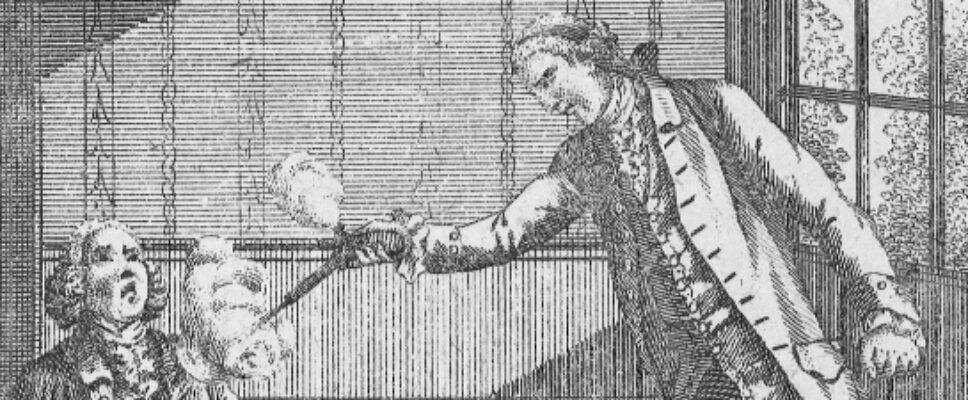
In Clouds, much mention is made of the Earl Ferrers’ trial in 1760 for murder.

After that, the Duchess of Kingston went up before the Lords in 1776 for bigamy. She escaped punishment by “pleading privilege” because it was her first conviction. In other words, she was given the legal equivalent of a mulligan. In 1841, the Earl of Cardigan was found not guilty of dueling, and in 1901, Earl Russell was found guilty of bigamy and given three months in jail.

Edward Russell appeared in a newsreel after being acquitted in the House of Lords of vehicular manslaughter.
The right to trial in the House of Lords was abolished in 1948.