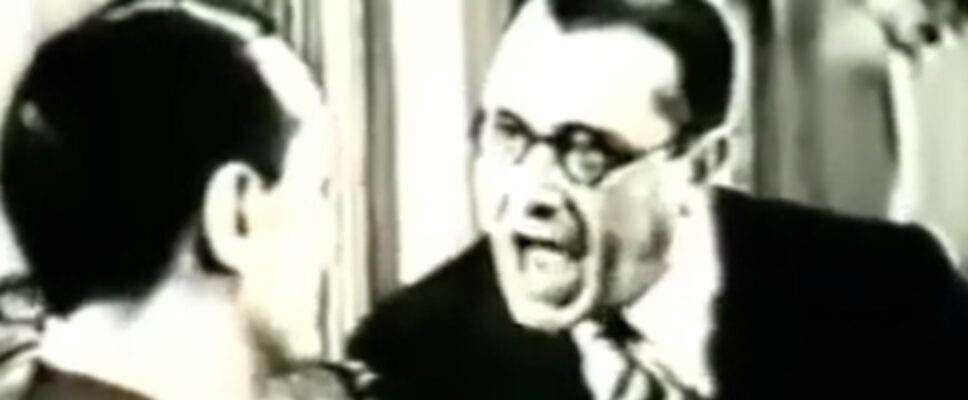
Teresa reviews Black Coffee (1932)
Teresa reviews Black Coffee (1932), the first film of the play Agatha Christie wrote, and the only one she wrote with Hercule Poirot in it.
Watch our livestream discussing the movie on YouTube.
Fidelity to play: 3 poison bottles
 The bones of the play remain, minus Japp. Add in a beclowned Hastings clone, fake poisoning, and other changes.
Quality of movie: 2½ poison bottles
 I think. The film stock was so awful, it was hard to tell what was happening. Subtitles were barely adequate, adding to the difficulty.
This film, Le coffret de laque, or The Lacquered Box, is the second filmed version of one of Agatha’s earliest plays, Black Coffee, which she wrote in 1930. It’s been filmed four times. The first film version from 1931 starred Austin Trevor as Poirot. It’s lost.

The main reason I could tell what was going on was because I’d just read Charles Osborne’s 1997 novelization of Agatha’s play. The play itself isn’t performed that often which is a shame. Based on Osborne’s rewrite, it’s decently paced, uses a small cast, takes place in easy to stage locations, holds together well, has comic elements, and works as a mystery. It’s perfect for local theater.

And so here we have a rarity on many levels. A once was lost but now is found film, in which Poirot, aided by Hastings and Inspector Japp, does the detecting. The French production company, not being content with Agatha’s proven and easy to stage play, enhanced it using all the tricks that she disliked. Does the actor playing Poirot resemble that character? He’s male. He wears a suit nicely. That’s it. I saw no references to him being Belgian in this French production. He towers over the Hastings clone. He waves a gun around. He’s renamed Préval, but all the characters got name-changes of one kind or another.
Hastings is rewritten into a clone and a clown. Instead of being Poirot’s loyal if not terribly bright sidekick, he becomes Gaston de Ravennes, the son of a chocolatier and a neighbor of the Amory family who just happens to be visiting on the night in question. He’s short and rotund. He and Préval have never met before, yet Préval instantly presses de Ravennes into service to guard the study during the night. It’s not clear why the great detective did this, other than de Ravennes is unrelated to the Amory household. You wonder even more when de Ravennes is fooled by the radio (cutting edge technology in 1932!) presentation of a Grand Guignol play about infanticide. De Ravennes doesn’t know the radio exists, doesn’t recognize the sound of one when he hears it, and panics, shooting off the gun and rousing the entire household. It turns out that Préval had loaded the handgun with blanks. Why would he do this unless he and de Ravennes already knew each other and he, Préval, had a good idea of how de Ravennes would react? I remain unsure because the jumpy, blurry filmstock and the bad subtitling make it possible to read the situation either way.
Another added complication was that this Professor Amory didn’t die of poisoning! He was ill, but faking his death. Like Mithridates (135BC – 63BC), he, according to Préval, had been taking poison in tiny doses to build up an immunity. Except I don’t recall seeing the professor again at the climax. And, and! There are two formulas! One is a fake decoy, made so if it got stolen, the professor still had the real formula tucked in his safe. It was confusing.
We also get added horseracing scenes so the characters can leave the house and confer with each other, make jokes, and cope with blackmailers. What the horseracing scenes do, like de Ravennes coping with a gruesome radio play, is ensure there’s not enough time for Professor Amory’s sister’s scenes. In the play, Caroline Amory gets plenty of stage time. She copes with her flighty flirtatious niece, tries to help her nephew’s troubled wife, knits, fills in details about the household to Poirot, and gets in the way of other characters. Since this is a French film, an older spinster gets disappeared in favor of horseracing scenes.
Lucie Stenay remains as Richard Stenay’s wife with a past. She toys with the poison, leading you to think that perhaps she did poison the professor. Her bête noire, Dr. Carelli, is suitably oily and goateed. But her husband, Richard, is almost not there at all. It took a while for me to work out who Richard was and I still couldn’t tell you if he cared what happened to his wife. I could tell Lucie apart from Henrietta, who also lost many of her scenes from the play.
The ending came from left field. So much time had been wasted with horseracing scenes and de Ravennes making a fool of himself that when Préval worked out that the secretary, Raynor, did it, that I couldn’t tell how. How Préval coerced Raynor to voluntarily confess was also handled poorly. It just didn’t make as much sense as Poirot carefully stationing Japp at one door to listen closely and Hastings at the other to substitute a non-poisoned whiskey and soda without being seen by Raynor.
Most of all, this film disappointed because it could — it should! have been filmed by the Poirot production company as part of David Suchet’s reign. Black Coffee would have been perfect: Poirot, Hastings, and Japp working together. They could have easily worked in Miss Lemon. That Black Coffee would have been delicious.