A Possible Inspiration For ‘Clouds of Witness’
SPOILER WARNING: This essay speculating about a possible inspiration for “Clouds of Witness” gives a very strong hint to the solution, so should be avoided if you want to read. It is taken from the Peschel Press edition of “The Complete, Annotated Clouds of Witness.”
Dying for love is a tale as old as time. Cleopatra took a serpent to her bosom after Antony’s death. Achilles mourned Patroclus’ death. or Harpalyce dying of grief after being rejected by Iphiclus in the Greek myths.

At 24, Johann Wolfgang von Goethe’s (1749-1832) debut novel The Sorrows of Young Werther caused a European sensation, thrilling readers and outraging moralists.
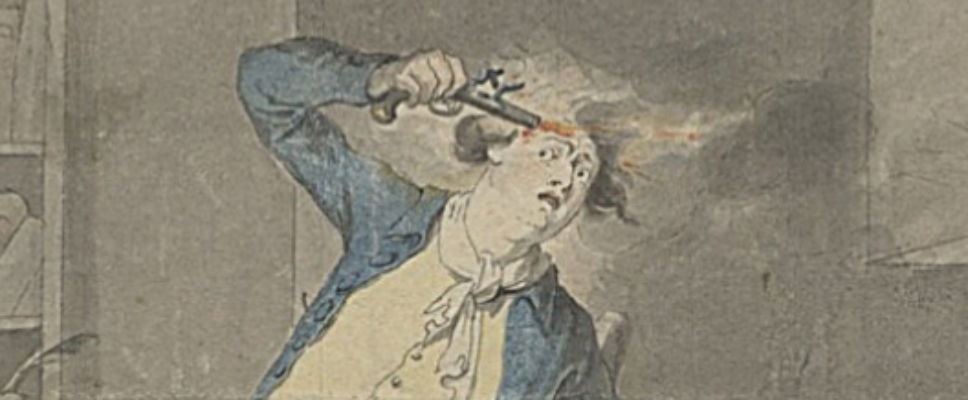
It’s easy to see why it touched a nerve with young men stuffed with hormones and emotions and short on sense. Werther, a sensitive romantic hero disgusted with society’s hollow values, kills himself rather than see his eternal love, Lotte, marry dull, plodding Albert. In a feat of romantic irony and supreme dickishness, Werther shoots himself with pistols borrowed from Albert.
Goethe didn’t have to look far for inspiration. As a lawyer in Wetzlar, he befriended Karl Jerusalem, who introduced him at a ball to Johann Kestner and his fiancée, Charlotte. Goethe fell deeply in love with 19-year-old Charlotte, but she preferred her stolid Johann. Seeing them happy together was too much. How could she reject a budding poet and artist for someone so dull and plain? Goethe fled Wetzlar in agony, but he kept in touch with the couple and even attended their wedding.
Goethe wasn’t the only young man feeling trapped by love. After a married woman rejected him, Jerusalem borrowed two pistols from Johann and shot himself. The lover in Goethe was miserable, and extreme emotion needs an outlet. The artist saw an opportunity.
The “It” Book of 1774
Written in only four weeks, Werther became the “it” book of 1774. In a culture bored with the cool rationality of the Enlightenment, Werther’s hot-blooded passion was a bracing tonic. The official edition was translated into several languages. Demand outpaced supply and pirated editions were snapped up. Writers followed with Werther-like stories. Fans could buy porcelain statues of Charlotte and Werther (made in China), or jewelry, gloves and even bread boxes featuring their images. Young men raced to their tailors to copy Werther’s signature blue frock coat with tin buttons, buff leather waistcoat, brown boots and round felt hat.

The only people not thrilled by Werther were the real-life models for Lotte and Albert. Kestner wrote Goethe, “The real Lotte would … be grieved if she were like the Lotte you have there painted.” But Kestner felt the sting of Goethe’s pen as well in his portrayal of Albert: “Need you have made him such a blockhead?”
Goethe tried to make amends, but he couldn’t resist taking a victory lap. “Say to her: ‘To know that your name is uttered by a thousand hallowed lips with reverence, is surely an equivalent for anxieties which would scarcely … vex a person long in common life, where one is at the mercy of every tattler.’”
Or maybe — for a man rejected in love — success is the best revenge.
Thackeray’s Parody
While Sayers portrayed Cathcart’s suicide over his Lotte as a tragedy, not everyone would think so. Novelist William Makepeace Thackeray (1811-1863) wrote “Sorrows of Werther,” which looked askance at Goethe’s novel:
Sorrows of Werther
Werther had a love for Charlotte
Such as words could never utter;
Would you know how first he met her?
She was cutting bread and butter.
Charlotte was a married lady,
And a moral man was Werther,
And, for all the wealth of Indies,
Would do nothing for to hurt her.
So he sighed and pined and ogled,
And his passion boiled and bubbled,
Till he blew his silly brains out,
And no more was by it troubled.
Charlotte, having seen his body
Borne before her on a shutter,
Like a well-conducted person,
Went on cutting bread and butter.