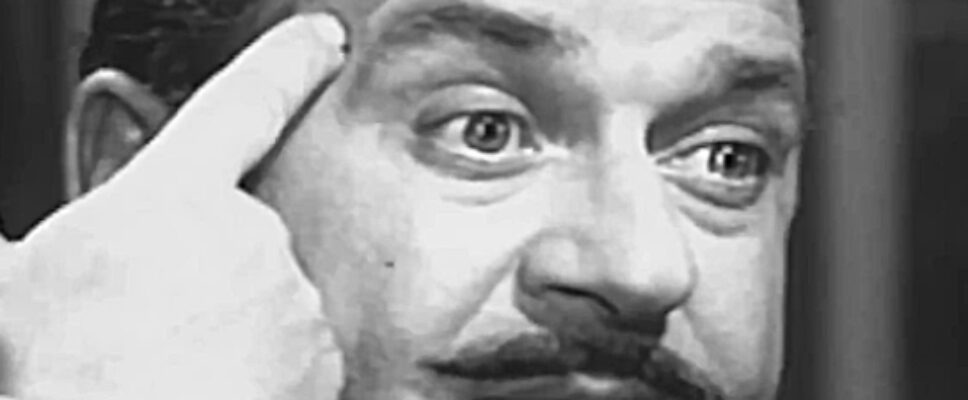
Teresa Reviews the Hercule Poirot TV Pilot from 1962
Teresa reviews the Hercule Poirot TV pilot from 1962 and wonders what would have happened if this serious take on the Belgian detective became a series.
Fidelity to text: 4 thieves

Despite showing Poirot moving to the U.S. and living out of his limo, the episode is remarkably close to the short story.
Quality of episode: 4 thieves
Well-cast, with a fast-paced plot introducing Poirot to a new audience.
Read more of Teresa’s Agatha Christie movie reviews at Peschel Press.
Also, follow Teresa’s discussion of these movie on her podcast.
File this little gem in your “what might have been” drawer.
 Hercule Poirot first appeared on the silver screen in 1931 with a badly cast Austin Trevor in the lead. Only one of Trevor’s three films survives, the 1934 version of Lord Edgware Dies. Poirot vanished from film until the 1950s when he popped up in a few half-hour appearances in TV anthology shows. Unless some collector has them squirreled away in their basement catacombs, they’re lost. Essentially, Poirot stopped existing on film in those pre-video and DVD days.
In 1960, it was announced that José Ferrar was cast as Poirot in a one-hour TV series titled, naturally, Hercule Poirot. Nothing came of it and not even a picture of Ferrar as Poirot can be found.
The next year, a new TV series about Poirot was proposed. It would focus on Poirot’s unique personality and distinctive detecting skills. It would showcase his love of solving unconventional crimes, which is why he’s traveling the world instead of remaining a top policeman in Belgium. It would — gasp! — travel outside the studio with varied settings, even international ones (think California palm trees standing in for Middle Eastern palm trees). It might even utilize Agatha’s own stories, although they’d be force-fed through Hollywood’s script-grinder.

A 30-minute pilot episode for Hercule Poirot was filmed, based on the 1923 story “The Disappearance of Mr. Davenheim.” I have no idea why the production company chose the story. It’s rather static. Poirot solves the crime from his armchair, like Baroness Orczy’s detective character, The Old Man in the Corner. Hastings sets up the story by reading newspaper articles about the shocking disappearance. Inspector Japp appears and makes a bet that Poirot can’t solve the crime. Naturally, he does and handily wins the bet.
The bet between Japp, Hastings, and Poirot is important because it survived the Hollywood script-grinding leading to a rather uncomfortable scene with Mrs. Davenheim.
Star Today, Forgotten Tomorrow
Since this is the pilot episode, designed to sell the show to a Hollywood studio for at least 30 episodes, a special actress was needed for the role of Mrs. Davenheim. And so, we get Nina Foch. Like Martin Gabel, she enjoyed a long, successful career with roles in The Ten Commandments (1956) and An American in Paris (1951). She also played Vera Claythorne in a TV version of Ten Little Indians (1959). Since she was a big name, Mrs. Davenheim was rewritten from a pleasant, bland, not very intelligent woman with no dialogue into a forceful, distraught woman desperately worried about her missing husband.

The Boston police are polite to Poirot; they know his reputation as an international crime-solver. He explains to them and to Mrs. Davenheim that he depends on the little gray cells to reveal the psychology of “why,” not the how.
And this is where the bet from the original story comes in. In front of his client (!), Poirot bets the Boston detectives that he can solve Davenheim’s disappearance from his hotel room. Mrs. Davenheim’s not happy seeing them treat her husband’s disappearance like a sport. But what can she do? She wants him back. Poirot tells her that he’ll find her husband, alive or dead. But he warns her: If he’s alive, she may wish he were dead.
Of the three versions of Davenheim, I’ve seen, this is the one that lets Mrs. Davenheim shine. This is also the only one that emphasizes her husband’s selfishness. Poirot must have realized this when he told Mrs. Davenheim that she might not be happy to get back a live husband.
Before he can solve the case, he must brush aside the red herrings. We hear about Mr. Lowen, a business rival, but only his picture appears on camera. Billy Kellett, petty criminal, is caught with Davenheim’s diamond pinky ring, and he identifies Lowen as the owner. There’s a lime pit nearby wherein bodies can be dissolved. The next day, the Davenheim bank collapses. Auditors arrive and discover widespread fraud.
Mrs. Davenheim returns to Poirot’s hotel room in shock. She’s penniless. Everything she owns, property, jewelry (what wasn’t stolen from the safe), cars, etc., must all be confiscated to pay creditors. She has nothing. She can’t even pay Poirot’s fee.
Poirot announces that she needs to meet the criminal Billy Kellett at the police station. In the hallway, she stares at him, transfixed with horror. He doesn’t say a word. I’d guess that as soon as Poirot heard about the rifled safe, conveniently full of money, jewelry, and bearer bonds, he knew the answer behind Davenheim’s disappearance.

He accepts the case and he’s off.
But First, A Word From Our Sponsor
Except, we’re not. After the end credits roll, Martin Gabel reappears as Poirot, talking to the screen to pitch the show to TV execs. He points out the worldwide popularity of Agatha Christie’s novels and hints at the exciting cases he’ll solve in future episodes.

Unfortunately, this series — establishing Poirot as competent, sophisticated, quirky, well-traveled, and very serious about himself and his detecting — wasn’t picked up.
Instead, in 1965, a new, decidedly unserious version of Poirot appeared in theaters in The Alphabet Murders. Tony Randall does the honors and while he could have made something of Poirot, the concept, the script, the cameraman, and the director all conspired against him. It’s awful, and Agatha’s novel about a serial killer was played for laughs! Her family even warned her not to see it.
Would this travesty had happened if Martin Gabel’s TV series had been picked up, been a success, and showed how Poirot should appear? We’ll never know, but it’s interesting to speculate.

