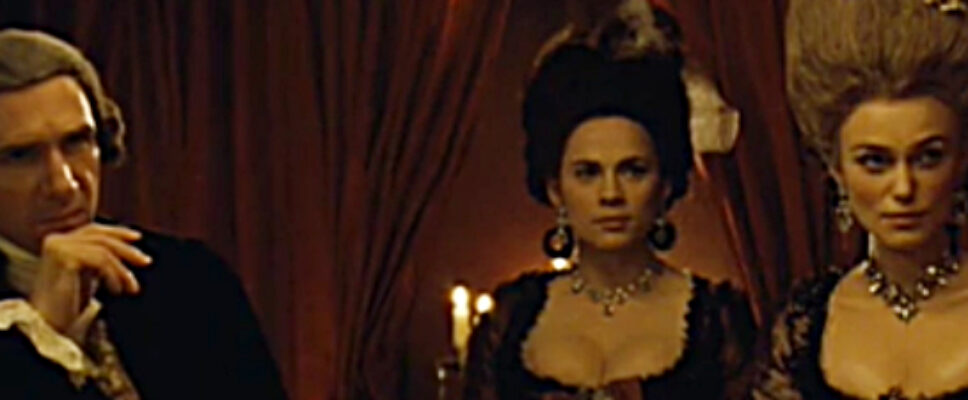
Teresa reviews The Duchess (2008)
Teresa reviews The Duchess (2008), a movie whose events take place during Jane Austen’s lifetime.
(c)2026 by Teresa Peschel
Fidelity to life: 3 stars
 The bare-bones facts about the duke, the duchess, and the live-in mistress are here, but, my goodness, did the film do serious rewrites to their histories.
Quality of film: 3½ stars
 Ralph Fiennes is amazing. Sumptuous, beautifully shot, acted, and paced to drag.
This is a part of a series of reviews that will be published in “Jane Austen, She Watched.”


Among its many historical inaccuracies, the film glosses over what every gentry and aristocratic family in England understood in their bones: If you want your direct family line to control your money-generating land and estates (some dating back to William the Conqueror (1028-1087)), the current holder must father a son. Preferably two or three or four. Children die young from disease, accidents, or fighting in England’s wars. Or worse, the union is barren and there’s no heir at all.
Jane understood this. If the marriage only produces daughters (like Mr. Bennet in P&P), the estate passes to a cousin and the daughters get nothing if they don’t marry well. Thus, if any of the Bennett sisters had married Mr. Collins, all would have been … not great for the unlucky sister, but she would have provided a home for her remaining sisters and their mother.
This is hard for a modern audience to fathom. Why do you need a son so badly? Can’t daughters inherit? Look at Queen Elizabeth, either of them. Or Queen Victoria. Yet in each case, there was no closer male heir in the line of succession. Some of Jane’s plots turn on this exact point.
Georgiana’s life with the duke provided plenty of gossip fodder. It’s true that she, the duke, and his mistress, her friend, Bess Foster, lived together, although the film’s salacious lesbian touch is unproved. Georgiana even raised the duke’s illegitimate daughter as part of their household. Throw in her compulsive gambling, her numerous affairs, Bess Foster’s numerous affairs, the Duke’s numerous affairs, tragic miscarriages, and you’ve got all the writing prompts you’ll ever need, particularly if you examine human behavior in the petri dish of a small neighborhood where no one can hide anything for long and gentry-class characters don’t get the pass on immoral behavior that the aristocracy receives.
In addition, Georgiana wrote and published two novels anonymously: Emma or The Unfortunate Attachment: A Sentimental Novel (1773) and The Sylph (1778). Could Jane have read them? We’ll never know. We know that Jane was familiar with Richard Brinsley Sheridan (1751-1816) and his plays, and he praised Pride and Prejudice as “one of the cleverest things he’d ever read.” That scene that Georgiana, the duke, and Bess watched from The School for Scandal (1777)? Jane played the gossipy Mrs. Candour in a private production. It’s hard to imagine now, but to Georgiana and Jane, that play was fresh and modern.
So how’s the film? It looks gorgeous. Carriages, grand houses, sweeping vistas of lawn, busy London streets; it’s all there. The costume designer should have won awards, along with hair, makeup, set design, and the location staff.
Sadly, the pacing drags. Georgiana and the Duke’s life was compressed into what seems about 10 years (1774 to 1784 or so), even though many events in her life such as her affair with politician (and future prime minister) Charles Grey took place outside this time period. Her other, many affairs were skipped over although the duke’s were not. Her compulsive gambling was touched on but you get the impression that she was a winner. She wasn’t. She lost. A lot. Like tens of thousands of pounds.
If you want to know this complex woman better, read Amanda Foreman’s biography Georgiana, Duchess of Devonshire (1998). You’ll also come away with a much more negative view of Bess Foster, the third person in Georgiana and the duke’s marriage. She’s far more manipulative than the film’s version. She also had only two sons that she didn’t adore like the film implies.
Georgiana’s biography may also give you more sympathy (may!) for the duke. Today, we’d assume that he was on the Asperger’s spectrum. He was famously cold and taciturn, and got on best with his dogs. People were a challenge. Ralph Fiennes managed to humanize this emotionally shut-off man. A lovely directorial touch early in the movie is showing him gazing at the young, fresh Georgiana sporting on the lawn through the wavy (and period-correct) window. This foreshadowed how separated they would be. He never saw her clearly.
Another great period-appropriate touch is the servants. There is never a moment when Georgiana, the duke, or Bess, or anyone else noble is unobserved. Footmen line the halls of the ducal estate, waiting to open doors. Lady’s maids see everything. When Georgiana, the duke, and Bess dine, servants waiting to serve listen to them bicker. The duke’s valet doesn’t appear, but he’d be there too, waiting to serve. How do the hidden servants know when to serve? By listening for a summons. They hear everything, including when they shouldn’t, by listening at doors. Are you at a picnic on the lawn? Servants hover, waiting and listening. Are you riding in your carriage? The coachmen can hear you. The footmen riding on the back can hear you. When the carriage stops, they can most definitely hear you. No one has any privacy.
Georgina is played by Keira Knightley, and this was a challenging role to perform. She is in nearly every scene, all told from her limited point of view. Yes, she married the duke on her seventeenth birthday. Yes, she was essentially sold by her family (Lady Spenser, her mother, did the deed) to the duke as a fertile, young broodmare. But remember, this is what young ladies of the aristocracy were raised to be! The times were very different. Ms. Knightly does her best to portray more than the put-upon victim, but she’s not given much to work with. The script didn’t have the space to let her show Georgiana’s complex life. A few sentences at the end give you the barest summary.
Watch The Duchess to get an eyeful of what Jane Austen observed from her perch in the gentry: rich people who had every advantage used their wealth to behave badly.