Bill Reviews The Pleasure Garden (1925)
Bill reviews The Pleasure Garden (1925), Alfred Hitchcock’s debut movie, and thanks a film pirate for preserving this bit of cinematic history.
(c)2025 by Bill Peschel
Quality of the movie: 3 Charlestons
 Even in the state it’s in, you can still follow the story and be in turn amused, teary, and shocked.
Hitchcockian: .5 Hitches
 You got to start somewhere. While the themes are there, there are flashes of his brilliant use of the camera that will be his signature brand.
Wow! Here we go! My review of the feature film debut by Alfred Hitchcock. The thought of it, as I write these words, leaves me exhilarated … and terrified.
You see, I didn’t realize what I was getting myself into. Sure, reviewing all of Hitch’s (you don’t mind if I get familiar from the get-go, will you?) movies and TV episodes he directed is a challenge, but Teresa and I did that with Agatha Christie, She Watched and the sequel International Agatha Christie, She Watched. And this won’t be nearly as big a book, a mere 54 movies and 20 TV episodes. That’s makes up 150-160 pages. The remakes and sequels by others adds another 33 (will I do those? I’m not sure to be honest). That’ll be about half of AC,SW and IAC,SW.
What I didn’t count on was something that should have been obvious from the start.
Namely, there’s tons of information out there about Hitch’s movies. Not just books about the movies, but examinations of their themes, styles, and behind the scenes gossip. And then there are the blog posts, and the Hitchcock wiki that’s stuffed with information.
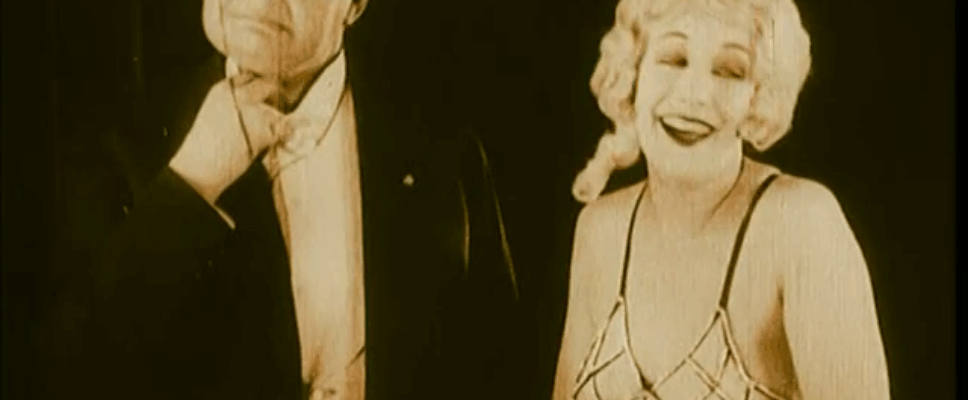
Which leads me to the version of The Pleasure Garden that I’m reviewing. What I saw is not the true Hitchcock version that moviegoers would have seen in 1925, but an hour-long edited version by Raymond Rohauer (1924-1987). Saying he was a film collector would be like calling Jeffrey Epstein a networker. Although he was instrumental in profiting off silent films through collecting and showing them, he was also a major abuser of copyright law. He would file suit claiming damages over showing films he did not, in fact, own the rights to. He would harass TV stations with lawsuits and they would pay rather than spend the money fighting it in court.
In the case of The Pleasure Garden, he recut the movie from its original run time of 92 minutes to 60, rewrote the intertitles, and put his name up front as “Raymond Rohauer Presents.” He did this to the films of Buster Keaton and other artists. He did this, not out of vanity or to improve the movies. It was so he could claim copyright over them and tell at a glance when one of “his” movies was being shown without the proper payments.
(If you want to go down the rabbit hole of his life and career, I highly recommend “Raymond Rohauer: King of the Film Freebooters.”)
I would love to watch the original version, and one exists. The British Film Institute began a fundraising campaign in 2010 to “Save the Hitchcock Nine.” They exhibited the restored movie in 2012, and have sat on it ever since. I don’t know what the deal is, but it’s typical behavior I’ve found with British institutions to hoard their treasure like Smaug.
The second thing I learned is that the script was based on the novel of the same name by Oliver Sandys, the pseudonym of Marguerite Jarvis (1886-1964). She was a British writer, screenwriter, and actress who wrote 149 romance novels under numerous pseudonyms, of which nine were adapted to the movies. Her novels were enormously popular in the mid-1920s, although by the 1950s the money was gone, spent on abusive lovers and two husbands, and she was living off a state pension awarded for her literary services. It’s a sad, old world we live in.
So, let’s talk about the movie I saw. Let’s learn together about Alfred Hitchcock and his movies!


The next day, Jill arrives at the back stage door with a purse full of money and a letter of introduction to the manager. She loses both to a pickpocket and can’t get into the theater. But Patsy see this naïve girl and takes her in like a stray dog. She learns that Jill has a boyfriend, Hugh, who shows up with his friend, Levet.

To everyone’s surprise, Jill’s an excellent dancer. She’s also not as naïve as she appears. The manager offers her five pounds a week; she counters with twenty. Within a few weeks, she’s a star and pursued by all the men. Hugh gets sent to an Africa plantation by his company, and Jill leaves Patsy’s apartment for her own place, the better to be courted by Prince Ivan.
Patsy’s depressed, but Levet comforts her and they marry. After their Italian honeymoon, he leaves for Africa to join Hugh.
There the story takes a darker turn. Levet reunites with his native-girl mistress in Africa, but succumbs to a fever. Patsy wants to go to him, but she has no money, and Jill prefers to use her money to prepare for her wedding than help her friend. But Patsy’s goodhearted landlord lends her the cash, and she travels to Africa only to find her husband in the arms of his mistress.


And that’s the movie. I don’t know what we missed from the BFI’s 85-minute version they’ve been sitting on for 13 years (a three-minute clip is on YouTube). But I’m grateful to the spirit of the king of the film freebooters. Without him, I wouldn’t have seen it at all.