Bill Reviews Der Hund von Baskerville (1914)
Bill reviews Der Hund von Baskerville (1914) and while visually interesting really needed some of D.W. Griffith’s innovations.
Fidelity to text: ½ hound
 Nothing like the novel. Holmes is a gun-toting sleuth, Watson’s an old man living in the basement, and the Hound is a big ole friendly dog.
Quality of movie: 1 hound
 Melodramatic, slow, and with all the characteristics of bad silent movies.
This is the first known adaptation of the 1902 novel, and it bears the usual flaws of movies made at that time.

The movie starts off excruciatingly slow, with the establishment of the Baskerville curse in the form of a giant hound, the sudden death of the previous Lord Baskerville, the writing of the letter to Henry Baskerville in New York informing him of the news, the adding of a warning by the turncoat butler (a villain who reforms in the third act), the scene of Baskerville in his club and someone bringing him the newspaper, followed by his receipt of the letter, his careful reading of it, followed by showing the audience the warning at the end of it.
If that seems like a particularly wordy sentence, just imagine that on the screen.
Events do pick up during the last hour. Henry meets a local lass, Laura Lyons, and the love connection is instant. After an attempt is made on Henry’s life, he calls in Sherlock.
We get a scene at 8 (?) Baker Street. In the glow of the firelight, Sherlock reads the letter, then presses a panel of buttons to summon Watson, a message spelled out on another panel of buttons using stop-motion animation.

This era — marked by fresh inventions and the novels starring Tom Swift and Frank Reade Jr. — spills into the Sherlock stories as well. This is the second silent movie I’ve seen in which he acts like he was Bond’s own “Q.” In The Mystery of the Leaping Fish (1916), a 25-minute parody starring Douglas Fairbanks, Holmes’ doorbell contains a TV monitor a la Ring doorbell, and he uses a high-powered telescope.
Hund was a lost movie until a copy was found with Spanish subtitles in Moscow. It was not in perfect condition. The scenes were out of order, and some scenes and title cards were missing. The subtitles were translated into English, more were restored, and the print tinted according to the instructions that came with the film.
This version was based on a play by Richard Oswald (1880-1963). When he became a script supervisor at Union-Vitascope studios, he took the opportunity to get his play filmed. It reflects the time by showing the scriptwriter, and then the director, awkwardly posing for the camera, and then by inserting the act’s number (perhaps so cinemas could show this as a serial?).
Very little of the novel made it into the movie. Instead of helping Holmes investigate, Watson is an old man living in Holmes’ basement. He’s seen once and never again.

The villain is Rodger Stapleton (played by Friedrich Kuhne (1870-1959)), a nephew who stands to inherit Baskerville Hall if Henry dies without an heir. Rodger also controls the hound, who looks more like a giant friendly Great Dane than a scary wolf and is kept in an underground cell on the grounds of his house.
The story revolves around Stapleton trying to kill Henry and Holmes thwarting him. There’s an amusing subplot when Stapleton, hearing that Holmes is coming, disguises himself as Holmes and establishes himself in the house first. Holmes shows up, realizes Stapleton’s plot, befriending the butler, and sneaks around the house.
There are a LOT of trap doors and gadgets to keep the audience distracted. In Stapleton’s office is a bust of Napoleon, perhaps a reference in the stories of Moriarty being “a Napoleon of crime.”
 The life-sized bust, situated on top of a cabinet, has removable eyes and is large enough for Stapleton to stick his head in and watch Holmes search his office. Stapleton’s chair has arms that can trap a person seated in it and dump him down a tunnel to meet the hound. The chute was designed to resemble an intestinal tract, which made it especially funny to see Holmes try to climb his way back up it.
Stapleton acts like your typical melodramatic movie villain, all shifty eyes and dramatic gestures. He’s also vain enough to write down his plans in invisible ink in a secret diary and leave it tucked into a couch for Holmes to find.

At the end, after escaping Stapleton’s traps and killing the hound (poor thing), Holmes reappears at the house disguised as Stapleton. Since Stapleton is playing Holmes, he can’t denounce the detective without revealing his identity. Holmes manages to get Stapleton alone. Stapleton pulls the disguise off Holmes. Holmes pulls a gun. Stapleton gets the gun, and Holmes tells him it’s unloaded. Stapleton backs into a suit of armor, which comes alive. It’s the butler! He holds Stapleton for the police and all is well.
Very silly.
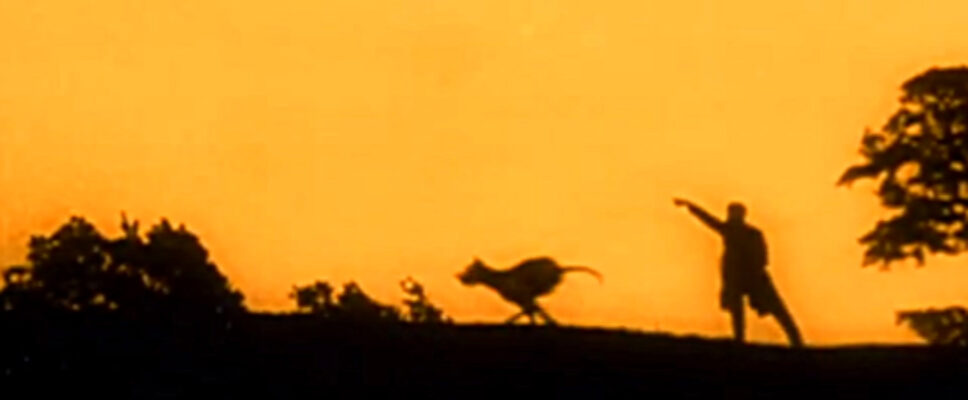
There are some well-composed scenes that suggest that the director had an artistic eye. The scene of Stapleton sending the Hound to attack Rodger was shot on a ridge in silhouette. Stapleton planting a bomb in a chandelier is viewed in a mirror’s reflection, in part to show him putting a chair on a table to reach it.
I can only imagine a Sherlock Holmes fan watching this and coming away disappointed. Not only is the story not The Hound of the Baskervilles, but Holmes is unlike Holmes. Alwin Neuß (1879-1935) has something of Holmes’ appearance, but he’s more an action hero than an intellectual detective.

And yet, the film made money. It was so successful that it spawned five sequels and prequels, each with its own subtitle (like Der Hund von Baskerville 5: Dr. MacDonalds Sanatorium). Neuß played Holmes in three of them, and Erich Kaiser-Titz (1875-1928) and Willy Kaiser-Heyl (1876-1953) in the last two. All of these movies are lost.
As the first adaptation, Der Hund von Baskerville stands as an example of how not to make a Sherlock Holmes movie. The innovations of D.W. Griffith couldn’t arrive fast enough.